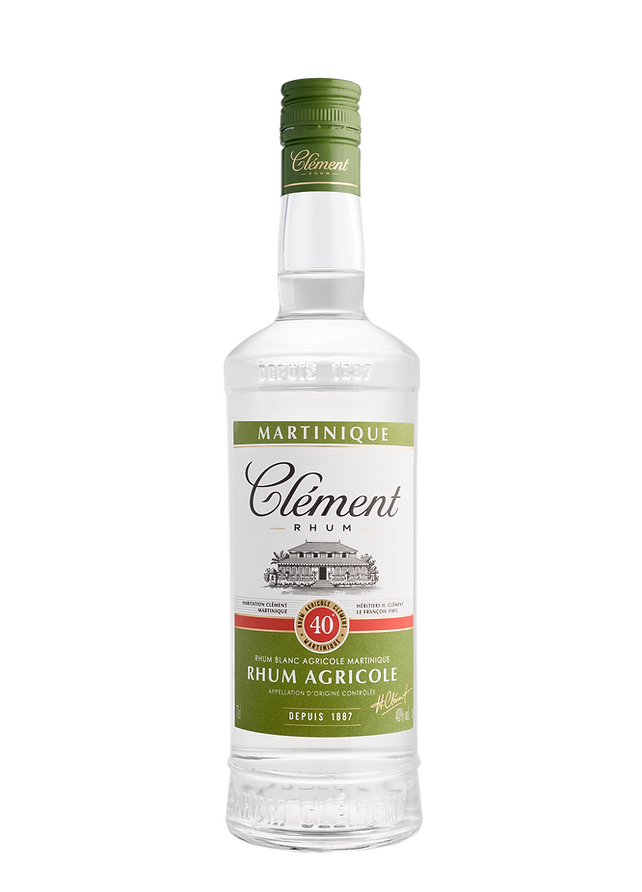
Rhum agricole, or agricultural rum, is the result of a nineteenth-century molasses shortage and the imagination of Homere Clement. Molasses is the primary ingredient of industrial rum. Without molasses, Clement, owner of an estate on Martinique, was forced to improvise. He analyzed the Grand Cru wine producers in France and the distillers of France’s great Armagnacs and Cognacs to perfect his method of rum production known today as rhum agricole. He treated the sugar cane like fruit and pressed it like a grape to extract the fresh natural juice. He then fermented a wine to distill and produced an eau de vie from sugar cane.
The Sugar Cane
Rhum Clement is still produced and estate bottled at Habitation Clement in Le Francois, Martinique. The island’s sugar cane is thought to be superior to other sugar cane in the Caribbean because of the Martinique’s volcanic soil and tropical climate.
Rhum agricole begins with only freshly-squeezed sugar cane juice, which can only be made when the sugar cane is at its peak of maturity, limiting production to a short season The sugar cane is planted in February and grows through the end in June. When the cane is fully matured, the field is set on fire in order to clear the weakest sugarcane. Then the canes are chopped as low to the ground as possible to get the highest concentration of sucrose. The cane juice is immediately distilled to make rhum agricole.
The Fermentation
Common (baker’s) yeast is used for the initial fermentation, although the process continues using the natural field yeast from the cane. The fermentation period can be anywhere from twenty-four hours to as long as seventy-two hours, resulting in Vesou, or sugar wine, of anywhere between 4.5 and nine percent ABV. Fermentation into this sugary wine is what develops the full-bodied flavors and aromas. The longer the fermentation process, the higher the concentration of the aroma.
The Distillation
Rhum agricole is distilled in single-column copper stills, which keep the strength of the spirit low. The length of the distillation, as well as the strength of the Vesou, plays an important part in this process, as does the physical makeup of the still. Small stills produce a heavy and low strength spirit. The tall still yields a higher strength spirit.
Preparation for Aging
After distillation, the fresh cane spirit is placed in stainless steel tanks to mellow. Each tank has a small perforated pipe and a release valve at the top. A stream of filtered air flows gently through the pipe, creating tiny bubbles which pass through the rum. This removes any unpleasant esters, which could take away from the full-bodied flavor of the rum. Over a period of nine to ten months, the rum is reduced gently with slow agitations in preparation for aging or bottling.
The Barrels
A complex mix of Limousin and American oak barrels are used to age the rum. The alchemy of rum and wood orchestrated by the cellar master is what gives Rhum Clementits distinctive character. The two woods impart their characteristically intense fragrance and complex aromas as well as their lively persisting flavors. The tannin in the barrels lends its amber color to the rum. The rum is placed in the barrels and stored in cellars, where it is aged by the same method pioneered by Clement. In the intense tropical climate of Martinique, there is a rapid loss of rum from evaporation through the barrel. This is commonly known as the ‘Angel’s Share’. Each barrel is topped off continually with rum from the same vintage.
About Rhum Agricole
Since 1996, the agricultural rums from Martinique are the only rums granted a French Appellation d’Origine Controlée (A.O.C.). A.O.C rums are at the top of the official French quality scale and must comply with legal restrictions on cane varieties, yield, distillation, aging and production zone. Rhum Clement is one of the leading producers of rhum agricole in Martinique. The Rhum Clement portfolio in the U.S. consists of Rhum Clement Première Canne, Rhum Clement V.S.O.P. Rum and Rhum Clement Liqueur Créole Shrubb.